
Circular economy and sustainability
RESEARCH INTO THE VALORISING TEXTILE WASTE USING INEJECTION TECHNOLOGIES
TEXPLAST
Motivation
The plastics industry is under increasing pressure to adopt more sustainable practices and reduce its environmental footprint. On the other hand, the enormous volume of textile waste generated annually worldwide is not only an environmental problem, but also an opportunity to exploit resources and reduce the dependence on virgin raw materials in the production of plastics. In this context, this project aims to carry out a revalorisation of textile waste as a key strategy to addressing the challenges of waste management and promote the circular economy.
Objectives
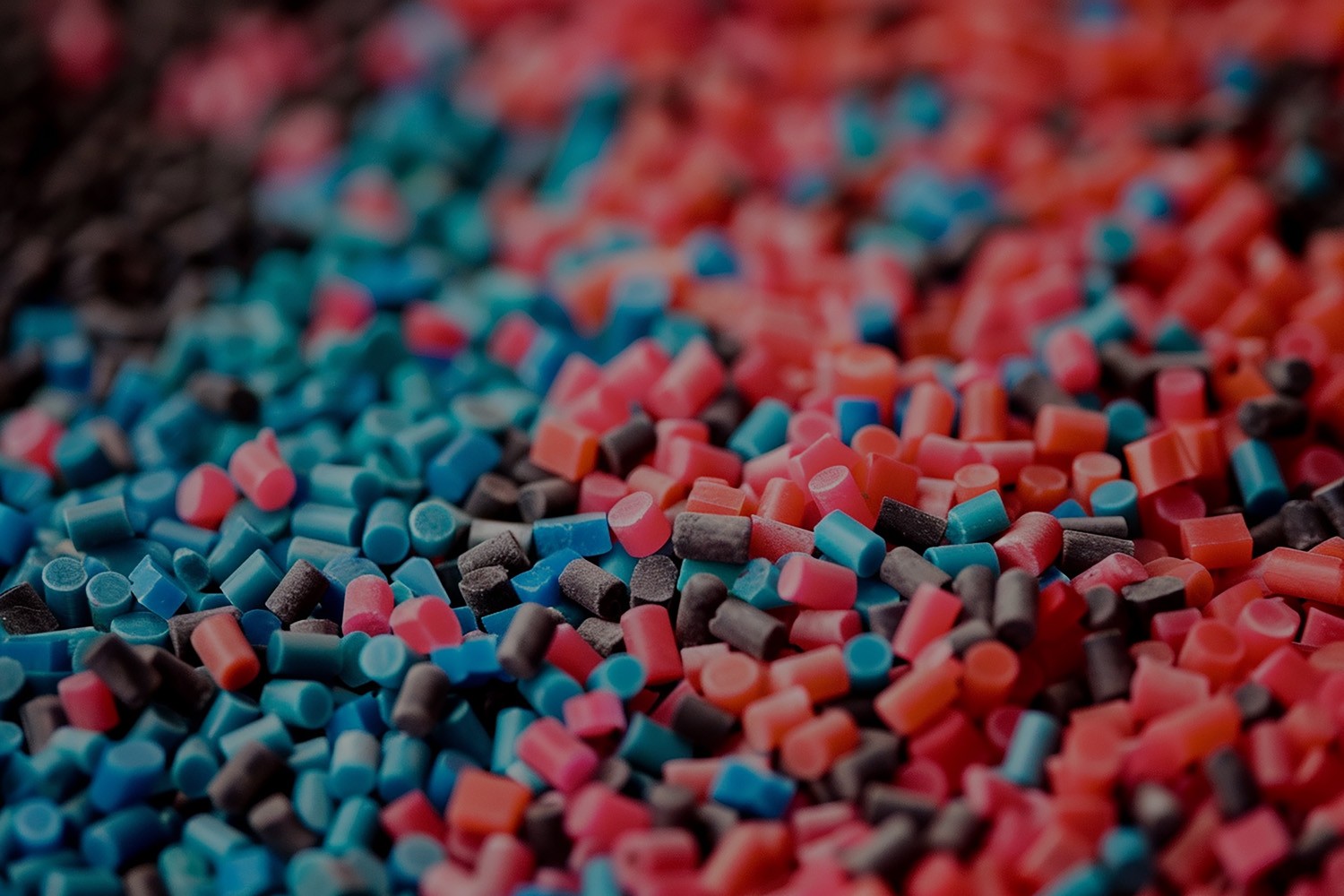
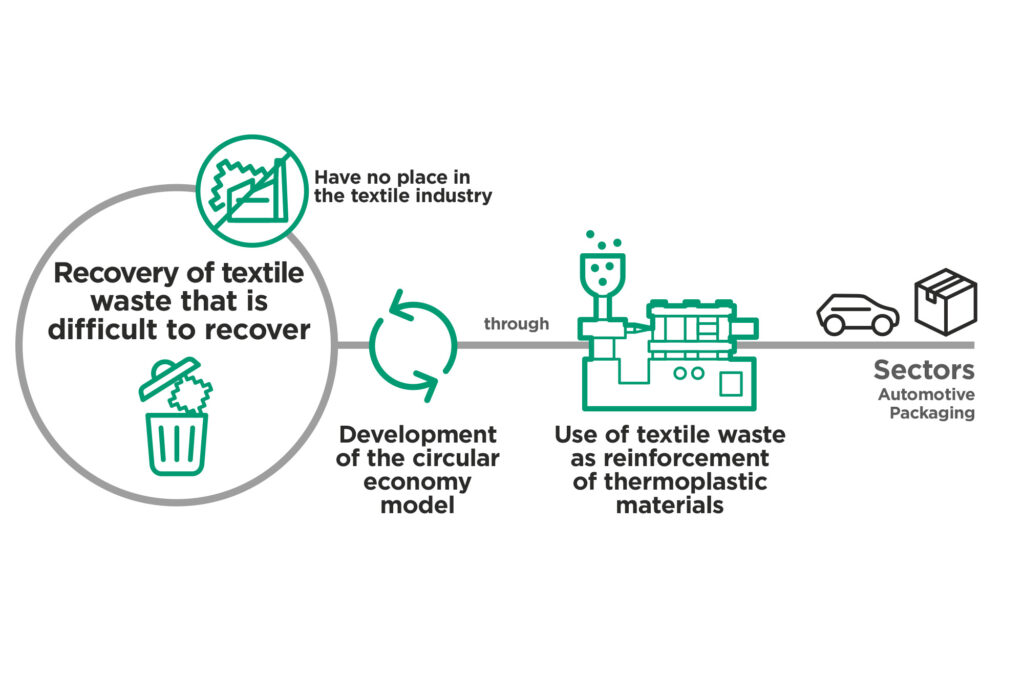
The main objective is the development of a circular economy model for textile materials that are difficult to recover and have no place in the textile industry itself. To this end, the potential for using textile waste in short fibre format as reinforcement of thermoplastic matrices in injection moulding will be analysed. The main challenge to be addressed is the introduction of a significant percentage of textile waste into the thermoplastic matrix. The initial approach will be for the potential for recovery of certain types of textile waste in the manufacture of plastic parts using 3D printing in a new technology uses the raw materials in pellet format.
Value and competitive advantage

-
Incorporation of textile waste in the form of pressed pellets, which improve mechanical properties.
-
The compaction of waste increases its density, facilitating its integration into injection molding processes.
-
Foundations are being laid to reduce costs through operational improvements and comparisons with potential competitors.
-
Provide sustainable solutions to integrate textile waste into the plastic industry.
Obtained results

Textile Waste Valorization
- Study and incorporation of up to 60% of textile waste as reinforcement in thermoplastic matrices through injection molding.
- Incorporation of textile waste in the form of pressed pellets, achieving results with good mechanical properties for the packaging and automotive sectors.
Environmental Impact
- Reduction of environmental impact in thermoplastic packaging products through the use of recycled materials from textile waste.
- Improvement compared to products such as a recycled plastic pallet versus a wooden one.
Economic Assessment
- Operational improvements are expected in the short term to make the pelletizing process economically viable for valorizing textile waste in the injection process in the near future.
Grant number: IMAMCA/2024/6
Programme: Plan of non-economic activities 2024
Period of execution: January 2024 – December 2024
Status: Finished
More information: PLAN OF ACTION
Entity: IVACE
Project supported by the Conselleria Conselleria de Innovación, Industria, Comercio y Turismo de la Generalitat Valenciana, through IVACE

CONTACT US
Do you want to contact us? Click on the button and write to us.
R&D AREAS

New high-performance functionalised materials

Circular economy and sustainability

Advanced manufacturing, smart textiles and digitalisation

High value-added solutions for strategic markets
RELATED PROJECTS


NEWS

AITEX is present at the Babykid FIMI fair at Feria Valencia from January 26 to 28, presenting tests and certifications for children’s products.

AITEX has attended the Cosmetorium fair in Barcelona once again on October to present its new products for the cosmetic sector.
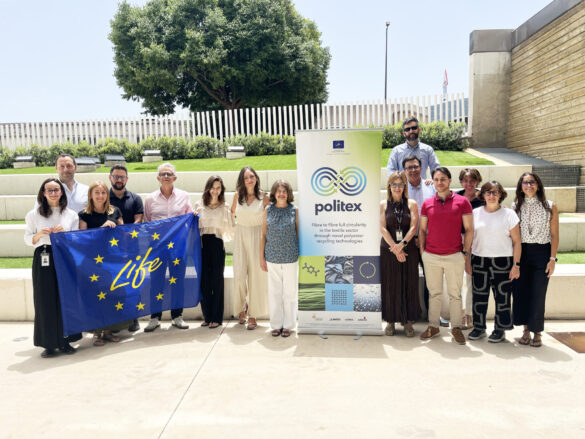
AITEX has hosted the LIFE POLITEX workshop entitled “Closing the textile polyester cycle: challenges and opportunities”, based on promoting sustainable solutions for the management and recycling of textile materials.