
Circular economy and sustainability
RECYCLING ARAMID FABRICS FROM BALLISTIC VIA GREEN SPINNING FOR SUSTAINABLE MATERIALS RECOVERY
REGEN
Motivation
The growing demand for defense equipment highlights the need for Europe to secure its supply chains. As the geopolitical environment continues to evolve, it is essential for Europe to explore options such as recycling and other circular solutions, emphasizing that self-sufficiency in raw materials is key.
Bulletproof vests represent a multilayer defense system designed to protect soldiers from a range of ballistic threats. One of the main layers of these vests is made of aramids, which are advanced materials widely used for their properties that contribute to the effectiveness of personal protection.
The service life of a bulletproof vest depends on several factors, including the materials used and the conditions under which it is worn. The typical lifespan is up to 10 years under normal conditions. However, exposure to ultraviolet light, humidity, and extreme temperatures can degrade the fibers, reducing their effectiveness. As a result, large amounts of waste are generated annually from these products, which is why a sustainable and efficient solution is sought to enable a circular economy and the development of new products from recycled materials.
Objectives
The REGEN project aims to advance maturity and demonstrate the technical and economic feasibility of recycling discarded protective vests made of aramid. In this way, REGEN seeks to take real waste from end-of-life bulletproof vests and recycle the aramid soft component of the vest, converting the woven material into a continuous fiber spool that can be processed and used for the remanufacturing of new bulletproof vests.
Expected results

-
Coating removal: study their impact on dissolution and develop chemical or physical methods for their elimination.
-
Spinning optimization: adjust parameters to produce high-quality fibers for yarns.
-
Filament production: generate suitable filaments from recycled fiber.
-
High-quality hybrid fabrics: combine virgin and recycled fibers; perform physical and mechanical testing.
-
Ballistic testing: integrate recycled yarns into hybrid armors and evaluate performance according to current standards.
-
Life Cycle Assessment (LCA): assess the environmental sustainability of the process in accordance with ISO 14040-44.
-
Techno-economic assessment (TEA): analyze recycling and manufacturing costs to determine the minimum selling price (MSP).
Grant number: 02 – 24.ISE.CP.140
Programme: 24.ISE.CP.140 — Proofs of Concept Aimed at Enhancing Circularity in Defence Applications
Period of execution: April 2025 – March 2026
Status: In progress
Entity: European Defence Agency


CONTACT US
Do you want to contact us? Click on the button and write to us.
R&D AREAS

New high-performance functionalised materials

Circular economy and sustainability

Advanced manufacturing, smart textiles and digitalisation

High value-added solutions for strategic markets
RELATED PROJECTS


NEWS

AITEX is present at the Babykid FIMI fair at Feria Valencia from January 26 to 28, presenting tests and certifications for children’s products.

AITEX has attended the Cosmetorium fair in Barcelona once again on October to present its new products for the cosmetic sector.
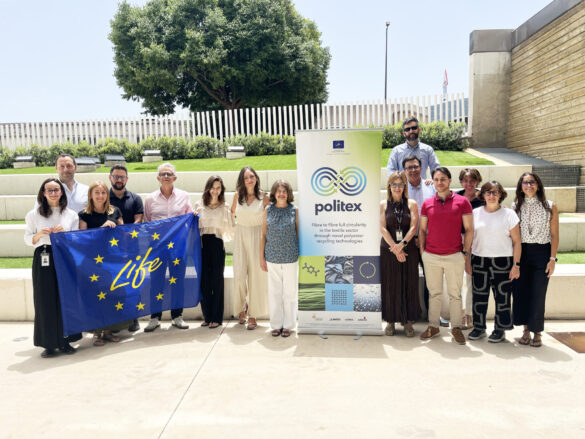
AITEX has hosted the LIFE POLITEX workshop entitled “Closing the textile polyester cycle: challenges and opportunities”, based on promoting sustainable solutions for the management and recycling of textile materials.