
Economía circular y sostenibilidad
CHEMICAL RECOVERY OF POST-CONSUMER TEXTILE WASTE
CHEMUP 2024
Motivation
In the last twenty years, global fibre production has doubled, and is expected to continue to grow exponentially in the coming years due to the increasing consumption of textile goods. The current system of textile production, distribution and use operates in an almost completely linear fashion and this, coupled with fast fashion, has led to significant problems of textile waste and its accumulation in landfills or incineration plants. As a result, the environmental impact associated with the textile sector has become one of today’s most worrying issues. The implementation of the circular economy in the EU aims to reduce the pressure on natural resources, promote sustainable growth, and create jobs in order to meet the EU’s commitment to achieving climate neutrality by 2050 and addressing biodiversity loss.
The action plan presents a number of initiatives covering the life cycle of products. It focuses on design, promotes circular economy practices, encourages sustainable consumption and seeks to prevent waste while ensuring that the resources used remain in the EU economy for as long as possible.
Objectives
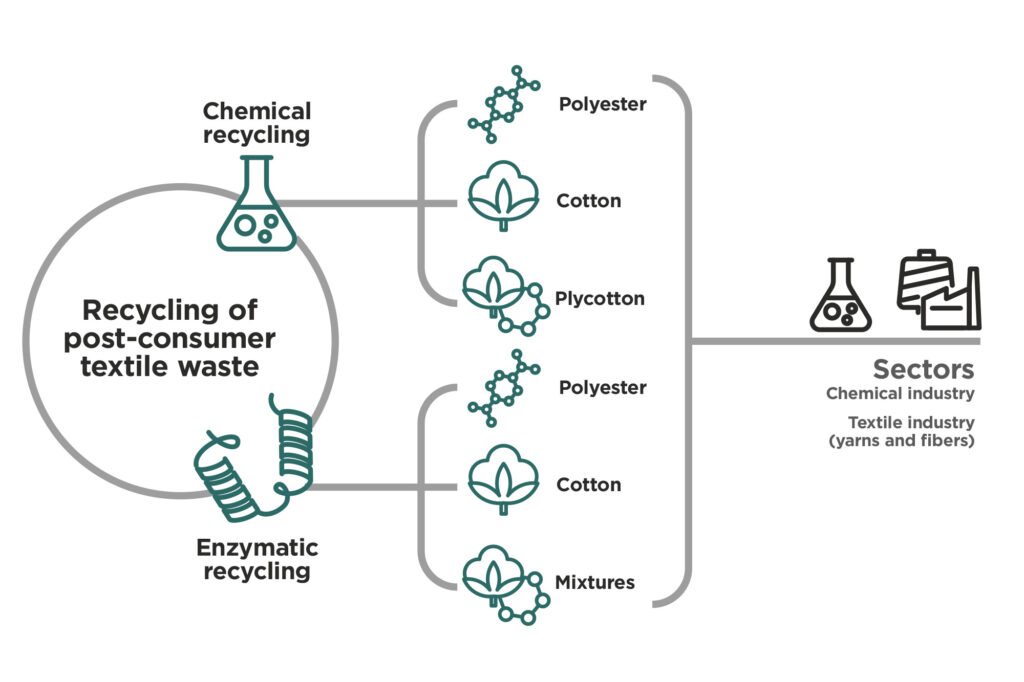
The overall objective is the study, validation and implementation of various recycling approaches, including chemical, enzymatic and thermochemical recycling of textile waste on various scales, depending on the maturity of the technology.
In the case of the chemical recycling of polyester and cotton, it is proposed to continue optimising and implementing the yarn manufacturing process. For the time being, the relative immaturity of the thermochemical and enzymatic recycling of textile waste means these approaches will studied and validated.
En este sentido, el objetivo principal del proyecto es investigar y desarrollar prendas textiles de punto para la integración de sensores y wearables que mejoren el rendimiento y rehabilitación en deportistas mediante la gamificación.
Value and competitive advantage

-
Implementation of chemical recycling techniques that contribute to a circular economy.
-
The development of technological solutions adapted to different types of fibers ensures staying at the forefront of the sector.
-
By optimizing recycling processes, the costs associated with waste management and the acquisition of raw materials are reduced through the reuse of existing materials.
Obtained results

-
Depolymerization of PET through glycolysis to obtain BHET and repolymerization to rqPET, with continuous process optimization, catalyst evaluation, and the adoption of sustainable practices to reduce environmental impact.
-
Development of recycled cotton spinning through wet spinning with ionic liquids, achieving optimal conditions for the production of continuous and aligned yarn, and efficient recovery of ionic liquid.
-
Research on enzymatic processes in the textile industry as an alternative to traditional chemical processes, using enzymes for the degradation of cellulose and polyester.
-
Use of enzymes to promote the recycling of textile materials, reducing pollution and the consumption of natural resources.
-
Advances in enzymatic engineering that improve textile recycling and encourage more sustainable practices in the industry.
-
Promotion of environmental sustainability in the textile industry through the adoption of innovative and efficient technologies.
Grant number: IMAMCA/2024/6
Programme: Plan of non-economic activities 2024
Period of execution: January 2024 – December 2024
Status: Finished
More information: PLAN OF ACTION
Entity: IVACE
Project supported by the Conselleria Conselleria de Innovación, Industria, Comercio y Turismo de la Generalitat Valenciana, through IVACE
CONTACT US
Do you want to contact us? Click on the button and write to us.
R&D AREAS

New high-performance functionalised materials

Circular economy and sustainability

Advanced manufacturing, smart textiles and digitalisation

High value-added solutions for strategic markets
RELATED PROJECTS


NEWS

AITEX is present at the Babykid FIMI fair at Feria Valencia from January 26 to 28, presenting tests and certifications for children’s products.

AITEX has attended the Cosmetorium fair in Barcelona once again on October to present its new products for the cosmetic sector.
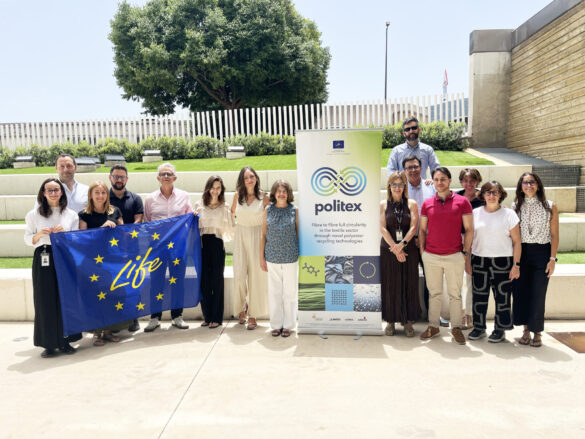
AITEX has hosted the LIFE POLITEX workshop entitled “Closing the textile polyester cycle: challenges and opportunities”, based on promoting sustainable solutions for the management and recycling of textile materials.