

Circular economy and sustainability
ARAGON’S REGIONAL HUB FOR CIRCULARITY: DEMONSTRATION OF LOCAL INDUSTRIAL-URBAN SYMBIOSIS INITIATIVES
REDOL
Motivation
In March 2020, the European Commission (EC) introduced the Circular Economy Action Plan (CEAP) (COM(2020)98), one of the main building blocks of the European Green Deal, a blueprint for sustainable growth in Europe. This transition to a circular economy within the EU holds the potential to alleviate strain on natural resources, foster sustainable economic expansion, and generate employment opportunities.
While Solid Urban Waste (SUW) is an abundant resource for circular product creation, it remains underutilized. In 2020, the EU generated over 500 kg of municipal waste per capita, with only 45% of it being recycled.
The feasibility of achieving true fibre-to-fibre (f2f) circularity is explored, relying on chemical technologies that reduce textiles to their basic components.

Objectives
- To develop and showcase novel management systems and processing technologies for effectively utilizing SUW as a resource for other industries and value chain.
- To produce recycled secondary materials from SUW that can be seamlessly integrated into downstream processes, thereby closing the production loop and promoting circularity.
- To work towards achieving a zero-landfill approach for SUW in Zaragoza by accomplishing recycling rates ranging from 55% to 100% within the REDOL value chains. Simultaneously, this will stimulate sustainable economic activity in the Aragon region.
- To establish a comprehensive roadmap for implementing REDOL solutions in various urban and industrial settings. This will address both technical and non-technical barriers to adoption.
- To ensure successful dissemination and exploitation of the project’s outcomes through a strategic and I-US-focused commercialization plan. This will involve the development of dedicated business models and active engagement with key stakeholders.
Expected results

-
Directly impact in the transition of Zaragoza towards a zero residues city, aiming at achieving this objective by 2040.
-
Such an approach will result in a total of 144.720 tons/year being re-used, valorised, or transformed into secondary raw materials instead of landfilled.
-
Develop and demonstrate a novel textile waste sorting technology based on hyperspectral imaging selection by colour, composition, and fabric/garment structure.
-
A depolymerisation-polymerisation process through glycolysis with ionic liquids will be optimised by AITEX at pilot scale (50 L) and also a glycolysis under microwave-assisted heating, both followed by post-condensation and spinning steps at pre-industrial demonstration level.
Visual materials
Grant number: 101091668
Programme: HORIZON-CL4-2022-TWIN-TRANSITION-01-10. Innovation Action
Period of execution: december 2022 – november 2026
Status: In progress
Entity: EUROPEAN UNION
Website: www.redolproject.eu

Funded by the European Union under GA number 101091668 – REDOL project.
The contents and opinions expressed are the sole responsibility of the author(s) and can in no way be taken to reflect the views of the European Union or the European Commission. Neither the European Union nor the European Commission can be held responsible for them.

CONTACT US
Do you want to contact us? Click on the button and write to us.
R&D AREAS

New high-performance functionalised materials

Circular economy and sustainability

Advanced manufacturing, smart textiles and digitalisation

High value-added solutions for strategic markets
RELATED PROJECTS


NEWS

AITEX is present at the Babykid FIMI fair at Feria Valencia from January 26 to 28, presenting tests and certifications for children’s products.

AITEX has attended the Cosmetorium fair in Barcelona once again on October to present its new products for the cosmetic sector.
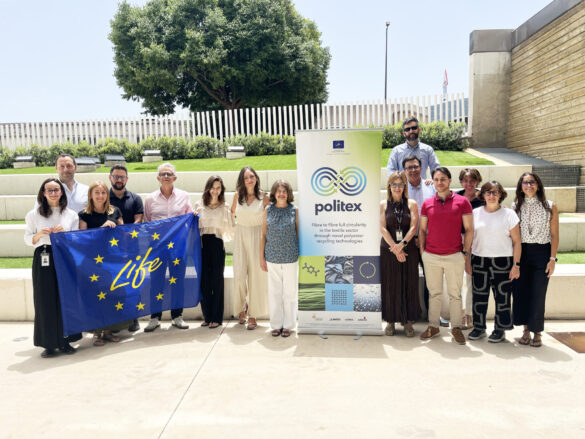
AITEX has hosted the LIFE POLITEX workshop entitled “Closing the textile polyester cycle: challenges and opportunities”, based on promoting sustainable solutions for the management and recycling of textile materials.